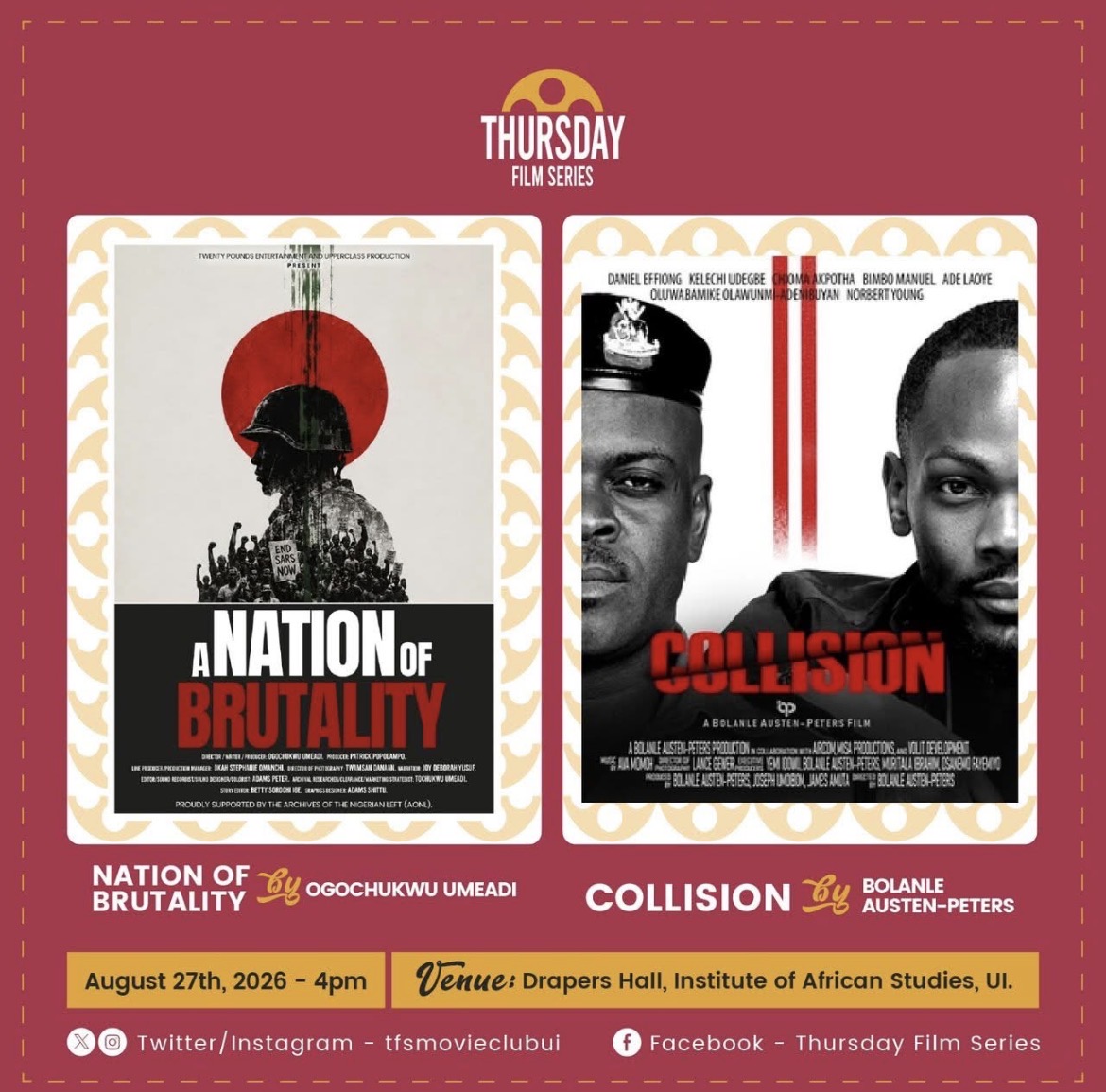
Two Nigerian films examining police brutality, institutional failure and the consequences of violence are set to screen together at the Thursday Film Series at the University of Ibadan on August 27.
The programme will feature Ogochukwu Umeadi’s A Nation of Brutality alongside Bolanle Austen-Peters’ Collision at Drapers Hall, Institute of African Studies, University of Ibadan, beginning at 4pm.
The screening brings together two films made in different forms and at different points in Nigeria’s recent cinematic conversation about police violence. While A Nation of Brutality is a short documentary, Collision is a narrative feature that examines the consequences of police corruption and brutality through the lives of a police officer and a young musician.
Umeadi’s A Nation of Brutality is listed among the filmmaker’s recent projects as a short documentary completed in 2026. Umeadi is a Nigerian producer-director whose work has included documentaries and other socially engaged projects, with his filmmaking practice spanning film, television and documentary production.
The film’s screening at the University of Ibadan is particularly relevant to the history of the Thursday Film Series. The programme has developed into a regular film and discussion platform at Drapers Hall, where students, filmmakers, academics and other members of the creative community gather to watch films and discuss social and cultural issues raised by them.
Previous Thursday Film Series programmes have addressed subjects ranging from environmental degradation and Nigerian literature to identity, elections, gender and human rights. Its screenings have also included discussions with filmmakers and scholars, making the post-screening conversation an important part of the programme rather than an addition to the film itself.
That format is particularly suited to A Nation of Brutality and Collision, both of which approach violence in Nigeria from different perspectives.
Austen-Peters’ Collision, originally released as Collision Course, was directed by Bolanle Austen-Peters and written by James Amuta. The 2021 film centres on Mide, an aspiring musician, and a police officer whose financial difficulties and involvement in roadside extortion eventually bring their lives into a devastating confrontation.
The film features Daniel Etim Effiong, Chioma Chukwuka Akpotha, Kelechi Udegbe, Ade Laoye, Kenneth Okolie, Bimbo Manuel, Bamike Olawunmi-Adenibuyan, Kalu Ikeagwu, Gregory Ojefua and Norbert Young, among others.
Its story is set against the backdrop of the widespread agitation over police brutality in Nigeria, particularly the issues that fuelled the #EndSARS movement. The film examines how economic hardship, corruption and abuse of power can place both citizens and members of law enforcement in destructive situations.
Collision has already had a substantial journey since its first public screenings. It was selected as the closing film of the 2021 Africa International Film Festival (AFRIFF), where Kelechi Udegbe won Best Actor in a Lead Role. The film subsequently received further recognition, including the Best Movie West Africa award at the 2022 Africa Magic Viewers’ Choice Awards.
The film later moved to Netflix, extending its reach beyond its festival and theatrical audiences.
Its return to a university film-discussion setting in 2026 gives the film another context in which to be examined, particularly by a younger audience that has lived through the aftermath of the #EndSARS protests and the wider national debate about policing and accountability.
For A Nation of Brutality, the Thursday Film Series screening provides a different kind of platform. Rather than presenting the subject only through a fictional narrative, the documentary format allows Umeadi to engage directly with the reality behind the subject.
The pairing is therefore deliberate. One film approaches the subject through documentary, while the other uses drama to examine the human consequences of institutional violence. Together, they create a broader conversation about what happens when systems created to protect citizens become sources of fear, abuse or trauma.
The event announcement describes the films as examining the lingering scars of police brutality and its effect on the collective psyche. It also frames the post-screening discussion around institutional failure, economic hardship and systemic violence, with the audience invited to consider accountability and what should follow after the violence has been documented and remembered.
That conversation remains relevant years after the 2020 #EndSARS protests, which brought nationwide attention to allegations of police brutality and demands for police reform. The protests grew from longstanding complaints about the Special Anti-Robbery Squad and wider concerns about the treatment of Nigerian citizens by security agencies.
The University of Ibadan has previously provided a setting for similar film-led conversations. In 2024, the Thursday Film Series hosted a special screening of Ebrohimie Road: A Museum of Memory as part of activities marking Wole Soyinka’s 90th birthday. The programme has also collaborated with organisations including IFRA-Nigeria on film screenings and discussions.
The August 27 screening will consequently bring together a documentary filmmaker and an established Nigerian director whose work has previously tackled difficult social subjects. Austen-Peters’ filmmaking has often moved between entertainment and social commentary, while Umeadi’s recent documentary work has similarly focused on stories with wider social implications.
For audiences attending the Thursday Film Series, the evening offers more than two films on the same subject. It creates an opportunity to compare two filmmaking approaches to one of Nigeria’s most persistent social concerns and to examine how cinema can preserve experiences that might otherwise become distant from public memory.
A Nation of Brutality and Collision will screen on Thursday, August 27, 2026, at 4pm at Drapers Hall, Institute of African Studies, University of Ibadan. A post-screening conversation will follow the films.